Interviewing
How to record family stories at home
· 6 min read
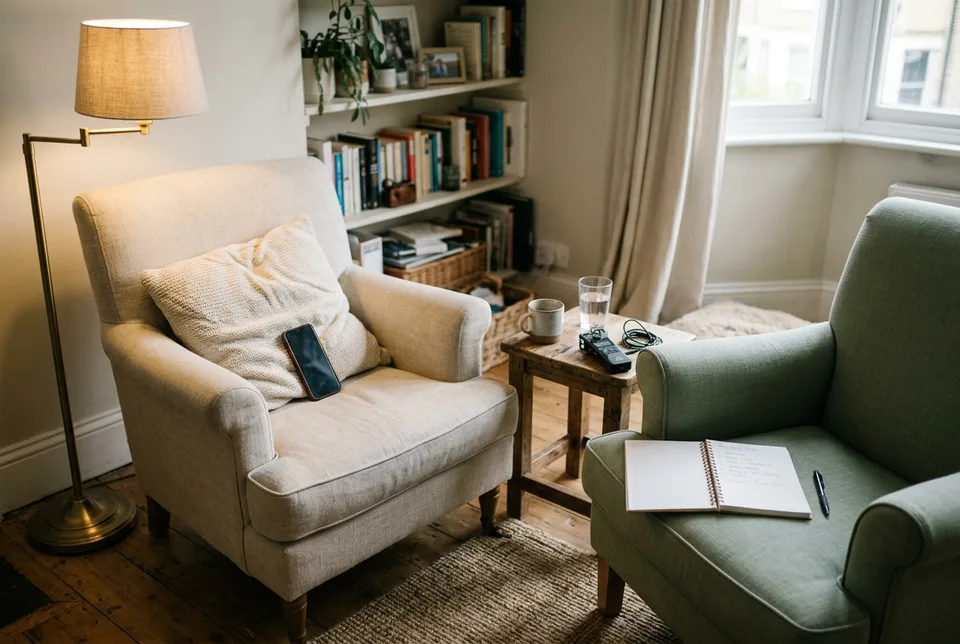
Record family stories with the voice memo app on any phone, placed on a soft surface within a metre of the speaker, in a room with soft furnishings and no running appliances. Name each file with the date and subject immediately after recording, transcribe it within a week while you still remember the context, and store a copy somewhere that is not the phone. Most lost family recordings are lost to broken phones, not bad audio.
The room matters more than the microphone
Speech recorded on a phone in a good room beats speech recorded on expensive equipment in a bad one. Hard, empty rooms create reflections that make voices sound distant and hollow, and no software fixes it convincingly afterwards.
A room with a carpet, curtains, a sofa and some books is close to ideal. Kitchens and hallways are the worst common choices: hard surfaces, and a fridge that cycles on halfway through a good answer.
- Turn off anything with a fan, motor or compressor within earshot.
- Close windows. Traffic and birdsong are more intrusive on a recording than in the room.
- Put the phone on a cushion or folded cloth, never a hard table.
- Sit within about a metre, and resist moving the phone once you start.
- Record thirty seconds first and listen back before committing to an hour.
Name files properly, immediately
The most common practical failure in family recording is not audio quality. It is ending up with forty files called "New Recording 12" and no memory of which is which.
Rename each file the moment you stop recording, while the content is fresh. A format like 2026-09-04-grandad-first-job is enough, and it sorts chronologically by default.
Transcribe within a week
Automatic transcription is now accurate enough on clear speech that correcting the output is considerably faster than typing from scratch. What software cannot do is supply context: who "he" refers to, the spelling of a village, whether a name is Aunt Cath or Aunt Kath.
Those corrections are easy in the week after the conversation and progressively harder afterwards. A transcript corrected a year later is usually a transcript with permanent gaps.
Back up before the next session
Treat a recording as irreplaceable from the moment it exists, because it is. The person may be unwell, may not want to repeat themselves, or may simply never say it that way again.
Copy each file off the phone the same day, to at least one place that is not the phone: a computer, a cloud drive, or an emailed copy to yourself. Two copies in two locations is the minimum for anything that cannot be recreated.
Keep the audio even after you have the text
Families consistently report that the recording becomes more valuable than the transcript over time, particularly after the person has died. A transcript preserves what was said; the audio preserves how they said it, including the laugh and the pause before a difficult answer.
Storage is cheap and an hour of speech is a small file. There is no reason to delete the original once a transcript exists.
Common questions
- What is the best app to record family stories?
- The voice memo app already on your phone. Its quality far exceeds what speech and transcription require, and using something familiar means less can go wrong during a session you may not be able to repeat.
- How do I get better audio quality at home?
- Choose a soft room over better equipment. Carpet, curtains and a sofa reduce the reflections that make voices sound hollow, and turning off nearby appliances removes the hum that no software fully removes later.
- Should I use automatic transcription?
- Yes, then correct it within a week. Software handles clear speech well but cannot supply context such as name spellings and who a pronoun refers to, and those details fade quickly.
- How should I store family recordings long term?
- At least two copies in two different places, at least one off the recording device. Keep the original audio permanently even after transcription, since families usually come to value the voice more than the text.