Interviewing
How to interview a parent or grandparent about their life
· 8 min read
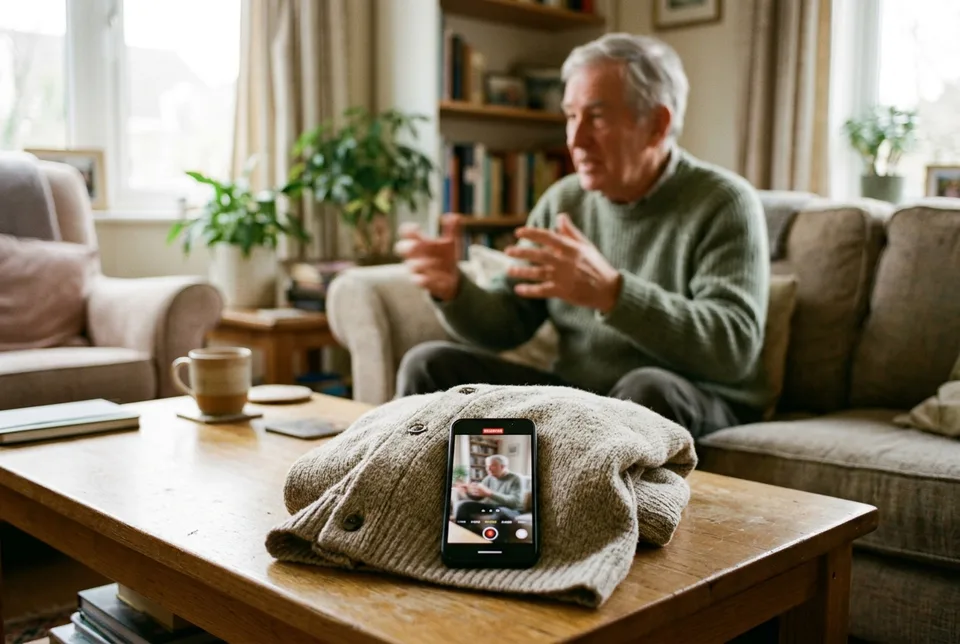
Record family interviews in sessions of 45 to 60 minutes, using a phone laid on a cushion or soft surface rather than a hard table. Ask one question and then stop talking; the most valuable material usually arrives after a silence that feels uncomfortably long to the interviewer. Work from a prepared list but follow whatever the person actually wants to talk about, and always ask what a place or a person looked like, because sensory detail is what makes a transcript readable.
What equipment do you actually need?
A modern phone is sufficient. The voice memo app on any phone made in the last decade records at a quality far beyond what a transcript requires, and dedicated recorders add cost without adding usable fidelity for speech.
What matters more than the device is placement. Put the phone on a cushion, a folded jumper or an armrest rather than a hard table, which transmits every knock and cup placement. Keep it within about a metre of the person speaking, and turn off anything with a fan or compressor in the room.
How long should each session be?
Forty-five to sixty minutes. Beyond an hour, both people tire and the answers shorten noticeably. Under half an hour, you rarely get past the rehearsed version of a story into the detail underneath it.
Expect the first fifteen minutes of the first session to be stiff. Almost everyone performs slightly when a recorder appears, and almost everyone forgets it is there by the second or third question.
The single most useful interviewing habit
Ask your question, then say nothing. Most people fill a three-second pause instinctively, and interviewers are worse at tolerating silence than the people they are interviewing. The material that arrives after a long pause is consistently better than the material that arrives immediately, because the immediate answer is usually the version the person has told before.
When an answer ends, resist moving on. "What else do you remember about that?" and "What did that look like?" will extend a two-minute answer into a ten-minute one more reliably than any new question.
Mistakes that shut a conversation down
Most failed family interviews fail for one of a small number of reasons, and all of them are avoidable.
- Asking two questions at once. The person answers the second and the first is lost.
- Correcting dates or facts mid-answer. It signals that accuracy matters more than the story and makes people cautious.
- Starting with the hardest subject. Grief, estrangement and regret are best reached in a later session, not a first one.
- Filling silences with your own memories. Your recollection prompts agreement rather than recall.
- Interviewing with several relatives in the room. People edit themselves in front of an audience, especially their own children.
Use photographs as prompts
A photograph is the most efficient interview question available. Handing someone a picture from 1968 and asking who else was there produces names, places and relationships that no direct question reaches.
Work through a box of loose photographs rather than an album. Albums have already been curated and captioned, which means the surprising material has usually been left out.
What to do with the recording
Transcribe it, then keep both. Audio is what families most value emotionally, and text is what makes a book possible. Speech-to-text software handles a clear recording well enough that correcting the output is faster than typing from scratch.
Back it up somewhere that is not the recording phone before the next session. Irreplaceable recordings are lost to broken and stolen phones every day.
Common questions
- How do I record an interview with my grandparent?
- Use the voice memo app on any phone, placed on a cushion or soft surface within about a metre of them. Record in sessions of 45 to 60 minutes, and back the file up somewhere other than the phone before the next session.
- What should I ask first in a family interview?
- Something specific and easy from early childhood, such as what a room in their first house looked like. Early memory is detailed and unguarded, which makes it a good warm-up for harder subjects later.
- How do I get short answers to become longer ones?
- Stay silent after the answer ends, then ask "what did that look like?" or "what else do you remember about that?" Follow-ups extend answers far more reliably than moving on to a new question.
- Should other family members be in the room?
- Usually not. People edit themselves in front of an audience, particularly their own children, and one-to-one sessions consistently produce franker material.