Getting started
What to include in a life story book
· 6 min read
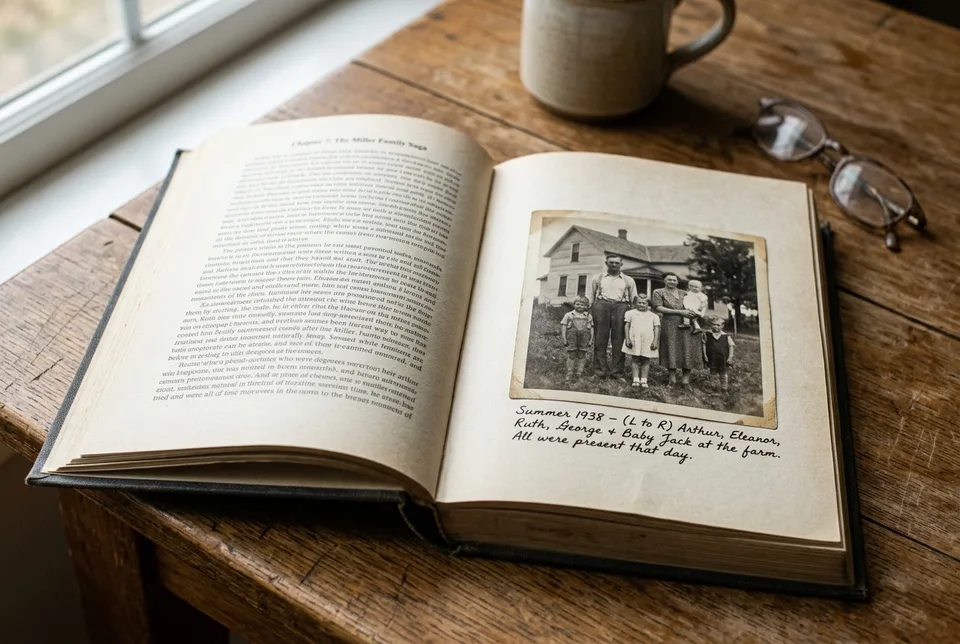
A life story book should cover childhood, family and traditions, working life, love and friendship, beliefs, and turning points, with photographs placed beside the stories they belong to rather than grouped in a separate section. The material families value most is ordinary domestic detail, which is also what people most often leave out because it feels too small to be worth recording.
The six chapters that cover most lives
These are not rules, but almost every complete life story book contains versions of them.
- Childhood and growing up: home, school, neighbourhood, fears, first friendships.
- Family and traditions: parents, grandparents, the things your family did without explaining.
- Work and money: first job, the trade you learned, the years that were hard.
- Love and friendship: how you met, what you argued about, who stayed.
- Belief and change: what you were certain of, what changed, what you would tell your younger self.
- Turning points: the decisions that redirected everything, including the ones that looked small at the time.
The material people leave out and regret
Asked what they want from a parent's life story, families consistently name the small things: what the house smelled like, what someone said when they were cross, what was eaten on a Tuesday. Asked what to include, the same people writing their own story dismiss exactly this material as too trivial.
The rule of thumb is that anything you would not think to mention because everyone knows it is precisely the thing nobody will know in forty years.
How many photographs, and where do they go?
Between 40 and 100 photographs suits a book of 150 to 250 pages. Fewer than 30 and the book reads as unbroken text; more than 120 and it starts to read as an album with captions.
Place each photograph beside the story it belongs to rather than collecting them in a glossy section in the middle. A picture of a kitchen next to the paragraph about that kitchen does work that the same picture cannot do fifty pages away.
Documents worth reproducing
Photographs are not the only thing worth scanning. These reproduce well and carry a lot of context.
- A handwritten recipe card, particularly in a relative's handwriting.
- A letter, or a single page of one.
- A school report, ration book, union card or apprenticeship paper.
- A ticket, programme or order of service from a day described in the text.
- A hand-drawn map of a childhood home or street.
What to leave out
Two things. First, anything you are including because you feel you should rather than because you want to; obligation shows in the prose and readers skip it. Second, material about living people that they would not want published, unless you have asked them.
Everything else can stay. A life story book has no length limit imposed by a publisher and no obligation to be balanced.
Common questions
- How many photos should a life story book have?
- Between 40 and 100 for a book of 150 to 250 pages. Fewer than 30 reads as unbroken text; more than 120 starts to read as a photo album with captions.
- Should photographs go in a separate section?
- No. Place each photograph beside the story it belongs to. A picture next to the paragraph it illustrates does work it cannot do in a separate plate section.
- What do families most want to read about?
- Ordinary domestic detail: what a house smelled like, what was eaten, what someone said when they were angry. This is also the material writers most often dismiss as too small to include.
- Should I write about difficult family events?
- Write them, then decide separately whether to include them. Drafting and publishing are two decisions, and treating them as one is why many people stop writing altogether.