Questions
Questions to ask your grandparents while you still can
· 7 min read
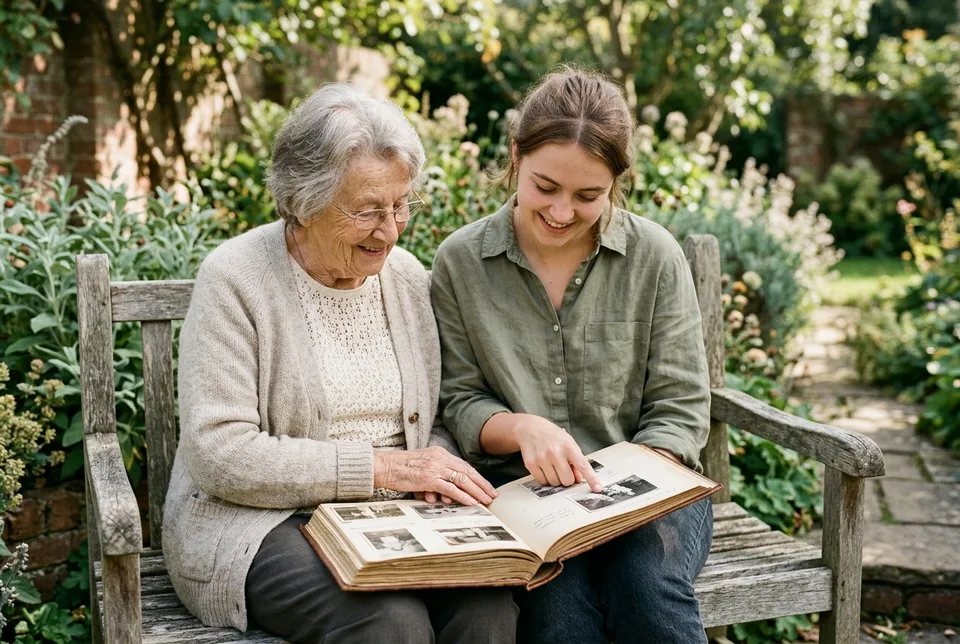
The most valuable questions to ask a grandparent are the ones only they can answer: what their own grandparents were like, what your parent was like as a child, and what the ordinary world looked like before you existed. A grandparent is the last living link to three generations back, and that information disappears entirely when they do. Ask about their grandparents before you ask about them.
Start two generations back
Most people interviewing a grandparent begin with the grandparent's own childhood. That is worth recording, but it is not the most perishable material in the room.
Your grandmother met her own grandmother. That woman may have been born in the 1890s, and your grandmother is the only person alive who can describe her: her voice, her house, what she was like to sit with. Nobody else can supply that, and there is no archive that holds it.
- What do you remember about your own grandparents?
- What did their house look like inside?
- What did they do for a living, and were they good at it?
- What did they say about their own parents?
- What is the oldest family story you were told?
Ask what your parent was like
This is the material that surprises families most, because it inverts the relationship everyone is used to. Your mother was once a seven-year-old who got in trouble for something, and only her mother remembers what.
- What was my mother or father like as a small child?
- What did they get in trouble for?
- What were they frightened of?
- When did you first realise what they would be like as an adult?
- What did they want to be?
- What do they not know about their own childhood?
Ask about the ordinary world, not the historic one
People interviewing older relatives tend to reach for headline history: the war, the moon landing, a famous election. Those answers are usually the least personal, because they have been told many times and shaped by decades of hearing other accounts.
The ordinary texture of a decade is far rarer and disappears faster. What things cost, how you got hold of a doctor, what you did on an evening with no television, what a street sounded like.
- What did a week's shopping cost, and where did you buy it?
- How did you find out news?
- What did you do on an evening at home?
- How did you contact someone in an emergency?
- What did your street sound like?
- What is gone now that you assumed would always be there?
How to ask when time is short
If a grandparent is unwell or very old, the temptation is to try to cover everything quickly. That produces thin answers and tires them.
Prioritise instead. Ask the questions nobody else can answer: their grandparents, their parents, their own children as small children. Anything documented elsewhere, such as public events or dates, can wait or be looked up. Twenty minutes on one well-chosen question is worth more than an hour of rushed coverage.
Common questions
- What should I ask my grandparents about?
- Start with their own grandparents, then what your parent was like as a child, then the ordinary texture of daily life in their era. These are the things that exist nowhere else once they are gone.
- What if my grandparent has memory problems?
- Long-term memory usually outlasts recent memory, so early childhood is often the most accessible subject rather than the least. Photographs and objects work better than direct questions, and short frequent sessions work better than long ones.
- How do I get started if we have never talked like this?
- Begin with an object or a photograph rather than a question about their life. Asking who is in a picture is a far easier opening than asking someone to talk about themselves.